
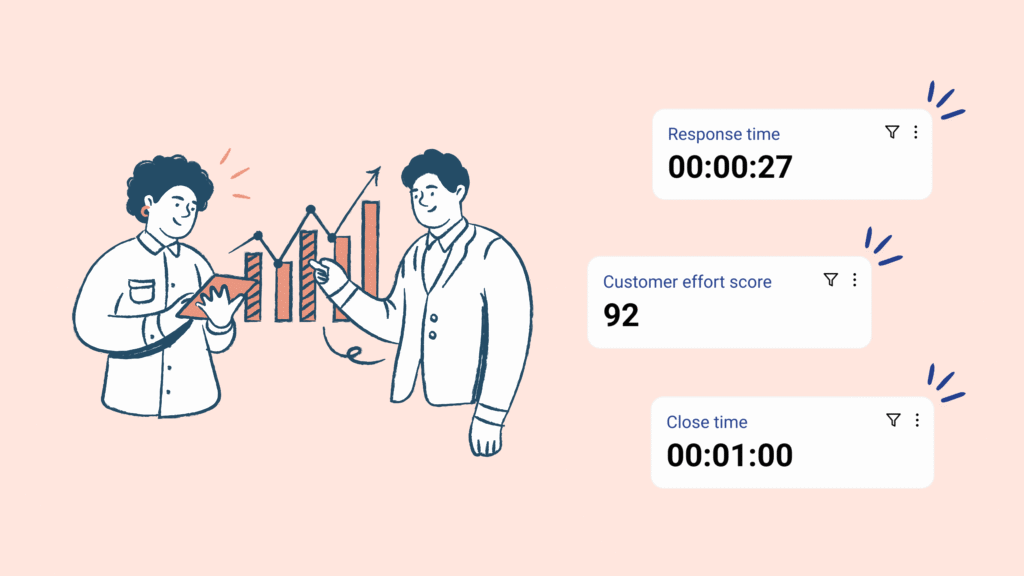
The world of SaaS moves at a rapid pace, with customer support no longer limited to closing tickets but instead, designed to provide significant customer experiences that lead to customer satisfaction, retention, and referral. The modern SaaS companies must re-engineer their metrics of customer support KPIs (Key Performance Indicators) to quantify what really counts the efficiency, empathy, and long-term customer value.
We are HiCustomers and we assist SaaS firms to rethink customer support performance by matching customer support services with growth-oriented measures and scalable frameworks. Our mission is to support a strategic growth driver, whether it be by outsourcing customer support, through multichannel service delivery or through remote support teams.
The Transition between the Traditional and Modern SaaS Support KPIs
Traditionally, the support teams were evaluated based on the response time, the number of tickets and the success rates. Although they remain crucial, they do not give the entire customer experience picture of the SaaS ecosystem.
The SaaS customer care in modern business centers around relationship-oriented metrics the monitoring of the quality of engagement, self-service adoption, and customer loyalty.
The most important change is the move from measuring efficiency to measuring effectiveness:
- The former KPIs: Average Handle Time (AHT), Tickets Closed per Day.
- New KPIs: Customer Effort Score (CES), Retention Rate, Net Promoter Score (NPS) and Expansion Revenue.
Developing these KPIs helps SaaS companies have a feel of how support directly influences customer retention and chances of an upsell.
Critical KPIs of the SaaS Customer Support Teams
When redefining KPIs, it is necessary to pay attention to the entire customer experience and not individual support contact points. The following are the most useful KPIs that contemporary SaaS companies need to monitor.
A. First Response Time (FRT)
What is the speed of customer response to the initial reply?
In SaaS, speed equals trust. A fast FRT in the form of chat, email, or in-app defines the whole experience.
B. Customer Effort Score (CES)
This is the ease with which users can seek assistance. The less the effort, the better the experience. Multichannel systems such as chat, email and social allow lessening of friction.
C. Net Promoter Score (NPS)
NPS also determines the level of customer recommendation of your product. High NPS is associated with strong SaaS support, which demonstrates that service quality leads to advocacy and renewals.
D. Customer Retention Rate
The final measure of good support is retention. HiCustomers allows SaaS brands to track engagement patterns through retention KPIs to determine when the customers are most likely to churn.
E. Quality Resolution and Escalation Rate
Speed of response is important but the quality of the resolution is success. Tracking escalation rates shows the number of times the first-line agents are required to receive the intervention of a higher level – an important indicator of team competence.
The Multichannel Customer Support Emergence
The modern SaaS consumers demand to be supported anywhere, be it live chat, email, helpdesk, or social media. Multiple-channel customer support defined in a multichannel customer support strategy gives users the possibility to address the support team using a channel that they like without any loss of context.
The multichannel SaaS support systems incorporated by HiCustomers are:
- Combine chat, email, and CRM data in a single dashboard.
- Provide real-time support and follow-up automation.
- Deliver touchpoint consistency and personalization.
This omnichannel solution improves customer satisfaction and support analytics as well, allowing teams to improve performance KPIs based on more enriching data.
The reason why outsourced and remote support is the future
This is because once the SaaS businesses start growing, 24/7 support becomes a problem. That is where customer support services and remote support teams are outsourced.
Contracting with expert partners such as HiCustomers enables SaaS firms to have 24/7 services without overloading the internal staff.
The important advantages of SaaS Support Outsourced:
- Cost Efficiency: Lessen recruitment, training, and infrastructure costs.
- Scalability: Which is The ability to increase or decrease the size of a team in accordance with demand.
- Experience: Presence of skilled employees who are knowledgeable about the SaaS processes.
- Globalize: Accommodate global users.
Moreover, chat support is also outsourced, and this is a way of ensuring real-time interaction- to keep the SaaS companies answering instantly and yet continue to enjoy customer satisfaction rates.
Service Desk Outsourcing: A Smoother Ticket Management
An outsourcing service desk concentrates the support processes and retains the brand. It offers SaaS companies:
- Combined ticket rerouting and classifying.
- SLA-based response tracking
- On-the-fly availability of customer satisfaction and efficiency indicators.
Bringing together automation and human knowledge, SaaS brands will be able to handle higher volumes of tickets and guarantee high CSAT (Customer Satisfaction Scores) and reduced churn.
Success Redefinition: KPIs with Growth
The support team of modern days should relate the KPIs to the business growth objectives. For example:
- Calculate Customer Lifetime Value (CLV) to get the long-term effect.
- Measure Customer Retention Cost (CRC) to equalize acquisition and support ROI.
- Take Upsell Conversion Rates using support-based engagements.
This alignment makes customer support a source of revenue, rather than an expense center, as it is one of the distinguishing features of scaling SaaS companies.
Final Thoughts
Redefining customer support KPIs is not an adjustment to reporting; it is a mentality change. New SaaS companies have to measure the results that have a direct effect on loyalty and expansion, rather than the speed of operations.
At HiCustomers, we assist SaaS brands with the implementation of outsourced, multichannel customer support and remote service desk solutions that can align the KPIs with retention and engagement as well as the revenue targets.
Your support functionality may be your most powerful source of growth-when you quantify what matters.
FAQs:
Q1. What is the need to redefine SaaS support KPIs?
Because now the traditional measures, such as ticket closure rates, do not allow for reflecting the overall experience of the customer. The modern KPIs are concerned with satisfaction, engagement, and retention.
Q2. What is multichannel customer support with SaaS?
It is a built-in support system that enables customers to contact through chat, email, helpdesk, or social media- and gives smooth, similar experiences in all channels.
Q3. What is the value of outsourced customer support to SaaS startups?
Outsourcing also offers professional talent, 24/7 availability, and scalability without the enormous overhead of having an in-house support system.
Q4. What is the use of KPIs to the outsourced support models?
They guarantee accountability of performance and transparency. KPIs such as the CSAT, FRT, and resolution rate monitor the quality of the service and the impact of the business.
Q5. So what is the difference between service desk outsourcing and customer support outsourcing?
Service desk and customer support are separate types of outsourcing, which include the technical and IT-related tickets and user-facing support, respectively.
Q6. What can remote customer support teams do to improve SaaS growth?
Remote teams facilitate 24-hour, worldwide support, better responsiveness, less downtime, and enhanced customer satisfaction across time zones.